
Free practice for the CTC online assessment
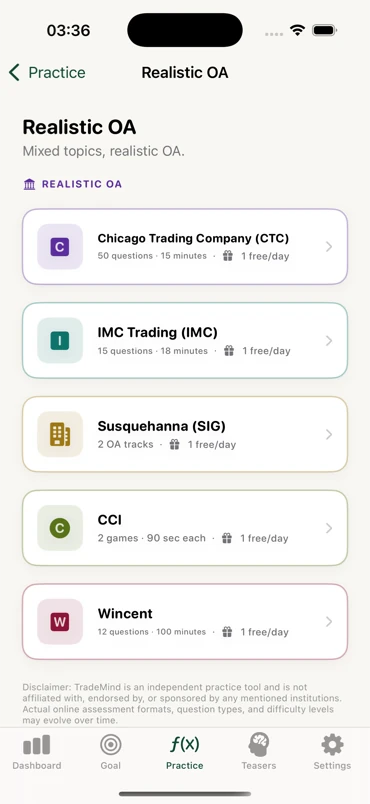
A full-length browser simulation in the style of the Chicago Trading Company (CTC) online assessment, based on public descriptions: 50 questions in 15 minutes of numerical, spatial, verbal, and logic reasoning, with no negative marking. Free, with no signup. Everyone gets the same fixed set.
Full CTC-style simulation
50 questions · 15 minutes · all four sections mixed · no negative marking · per-section scores
CTC OA format
| Length | 50 questions · 15 minutes (≈18 seconds per question) |
|---|---|
| Scoring | +1 per correct answer · no penalty for wrong answers |
| Format | Multiple choice, four question families mixed together |
| Pass mark | No published cutoff. Format and scoring may vary by region, role and recruiting cycle. |
| Sections | Numerical reasoning · Spatial/abstract reasoning · Verbal reasoning · Logic & attention to detail |
The CTC aptitude test and Chicago Trading Company OA are the same test
Search results use several names for one early screening test: CTC OA, CTC online assessment, CTC aptitude test, Chicago Trading Company OA, and Chicago Trading Company aptitude test. All of them describe the same reported format of 50 mixed-reasoning questions in 15 minutes with no negative marking. This page simulates that format, free and with no signup.
The four question families
1. Numerical reasoning
Business-style arithmetic under time pressure: percentage increases and discounts, number series, averages with a missing value, compound depreciation, work rates, simple probability, and pay-structure algebra. None of it goes beyond solid mental arithmetic, but 18 seconds leaves no time to set up equations slowly. Drill until the approach is instant. The arithmetic itself is the easy part.
2. Spatial / abstract reasoning
Pattern completion (a shape rotating by a fixed angle each step, or gaining one side per step) and odd-one-out puzzles. These reward recognizing which rule family applies within a couple of seconds. Rotation, counting, and fill/outline alternation cover most of what appears.
3. Verbal reasoning
Antonyms of capitalized words, fill-in-the-blank sentence completion, and analogies (BAG is to CARRY as…). For non-native English speakers this is usually the highest-variance section, because vocabulary takes much longer to build than arithmetic speed. If that applies to you, start verbal practice first and keep a list of every word you miss.
4. Logic & attention to detail
Column-comparison questions (how many of five company names match exactly between two columns?), letter-series puzzles where each position steps through the alphabet independently, and True/False/Uncertain syllogisms. The attention-to-detail questions are easy points if you scan systematically, left to right and pair by pair, instead of eyeballing.
CTC OA strategy
- Never leave blanks. With no negative marking, a blank scores zero and a guess has at least a 20% chance of being right (more after eliminating an option). In the last 30 seconds, answer everything left.
- Bank the fast families first. Attention-to-detail and syllogism questions take 8 to 10 seconds with a system; a multi-step depreciation problem can take 40. Learn how long each family takes you, and move on from slow questions instead of perfecting them.
- Train switching between question types. Much of the difficulty is moving from a percentage problem to a rotating hexagon to an antonym in consecutive questions. Full mixed simulations train this; isolated drills do not.
- Fix your weakest family in isolation. After each full run, this page shows your score by section. Drill the weakest section untimed with worked explanations, which the practice modes in the TradeMind app provide.
Related practice
The full list is on the free tests page.
Questions
What is the CTC Online Assessment?
Chicago Trading Company (CTC) screens candidates for trading and related roles with a timed online aptitude test. It is widely reported as 50 questions in 15 minutes, mixing four question families: numerical reasoning, spatial/abstract reasoning, verbal/linguistic reasoning, and logic & attention to detail. That's an average of 18 seconds per question.
What is the Chicago Trading Company OA?
"Chicago Trading Company OA" and "CTC online assessment" refer to the same early screening test: a timed mixed-reasoning test candidates report as about 50 questions in 15 minutes. Unlike Optiver-style mental math speed tests, the CTC-style format mixes four families (numerical, spatial, verbal, logic) and is commonly reported to have no penalty for wrong answers, so finishing every item matters more than pure arithmetic speed.
What is the CTC aptitude test?
CTC aptitude test is another name candidates use for the Chicago Trading Company online assessment (CTC OA): a timed mixed-reasoning aptitude screen, widely reported as 50 questions in 15 minutes covering numerical, spatial, verbal, and logic. It is the same test as "CTC OA", not a separate exam.
What is the Chicago Trading Company aptitude test?
The Chicago Trading Company aptitude test is the same assessment as the CTC OA / CTC online assessment. Candidates report 50 mixed questions in 15 minutes with no negative marking. This page is a free, no-signup practice reconstruction of that format.
Is there negative marking on the CTC OA?
Candidates report no penalty for wrong answers, so your score is the number of correct answers. Never leave a question blank. If time is running out, guess on everything remaining.
How does this CTC-style page calculate my score?
This fixed web set reports raw correct answers out of 50. Wrong and skipped answers both add zero; neither subtracts a point. For example, 38 correct, 10 wrong and 2 skipped is 38/50. This is how the TradeMind simulator scores; CTC's current format and scoring may vary by role, region and cycle.
What score do you need to pass the CTC OA?
CTC does not publish a pass mark, and it likely varies by role and cycle. There is no widely cited single number the way ~60 net is discussed for Optiver-style 80-in-8. The practical goal is to maximize raw correct answers under heavy time pressure. Most candidates find time and context-switching harder than any single question.
How should I prepare for the CTC OA?
Practice under full timing. No single question is hard; the difficulty is answering 50 in 15 minutes while switching between four different question styles. Full timed simulations train pacing, and untimed section practice in the app fixes your weakest family.
Is it the same questions every time?
Yes. This page has one fixed 50-question set, the same for every visitor and every retake, so scores here are comparable between people. Retaking it will inflate your score, because you will be recalling the questions rather than solving them. The TradeMind app generates a new 50-question set on every run.
Is this the real CTC test?
No. This is an independent practice reconstruction based on public descriptions of the format. It trains the same skills and timing, but the questions are not CTC's. TradeMind is not affiliated with Chicago Trading Company.
TradeMind is an independent training tool and is not affiliated with, endorsed by, or connected to Chicago Trading Company. This simulator is a reconstruction based on publicly available descriptions of the assessment format, for practice only. Question content is procedurally generated and does not reproduce actual test material.